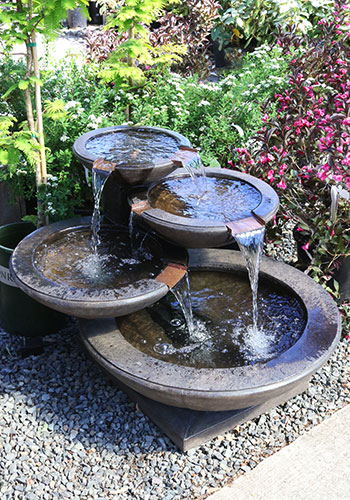
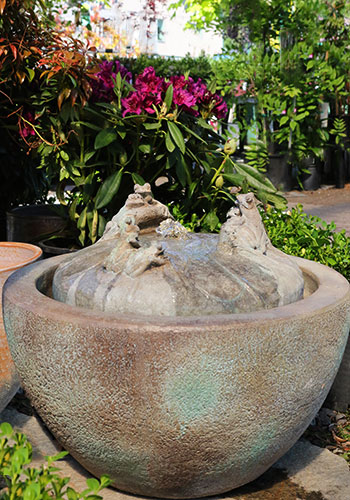
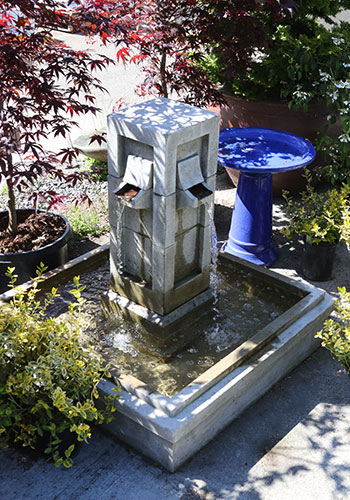
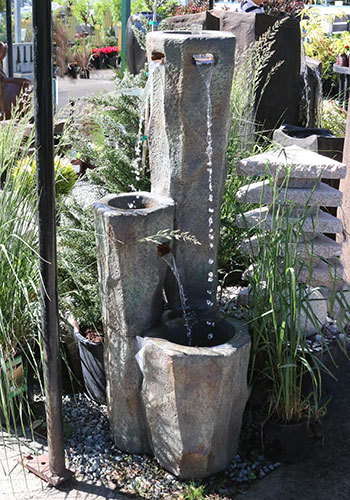
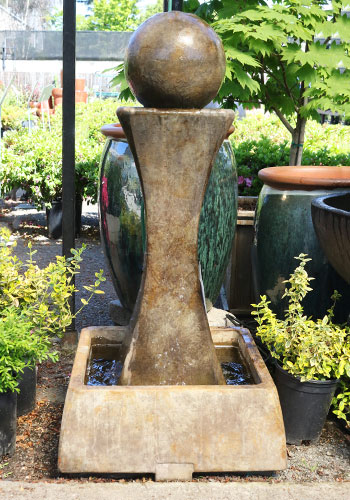
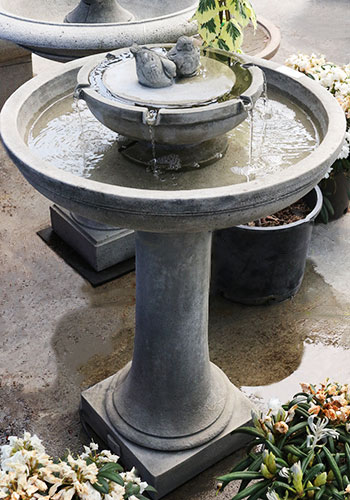
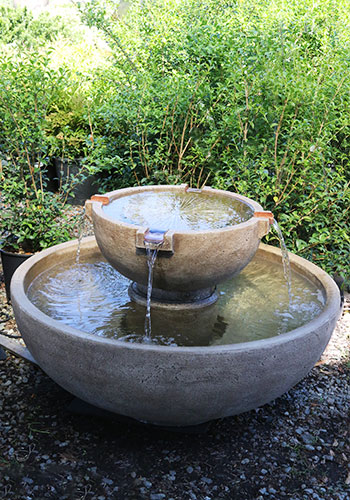
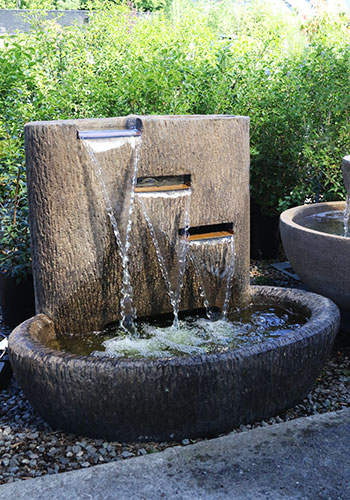
Most self-contained fountains are extremely easy to set up. The weight of larger pieces may be the only difficulty. Whether you are installing yourself or hiring a company to do it for you, it’s important to consider each of these details ahead of time. The more you prepare, the sooner you can enjoy your new fountain.
Foundation - The fountain must be set on a stable, level foundation of concrete or crushed gravel. Gravel should be 4 inches deep and level. For small to medium fountains and fountains on decks you can use unsupported concrete pavers with no sub-layer of gravel. An inadequate foundation can lead to:
- Fountain settling and tumbling
- Cracking due to uneven support of weight
- Moisture from the soil degrading the fountain surface
Electricity - All fountains have standard 3-prong plugs on cords extending 1 - 15 ft. from the bottom of the fountain. To power your fountain, you will need an outlet nearby. If you don’t have one, you will need to install an outlet and conduit to reach the site. Consider if you would like to bury the conduit so that the wiring is hidden. Even if you plan to setup the electrical later, make sure you have an outdoor extension cord available to test the fountain at the time of installation.
Water Source - The install team will need to fill and test the fountain, so make sure you have a water source ready to go. If installing yourself, fill the fountain to test that the fountain is level.
Structural Support - If the fountain is going on an elevated surface (ie. a deck), confirm that the location is capable of supporting the weight of both the fountain and water.
Modifications - Do you plan on making any modifications to the fountain? Some fountain owners install auto refill devices and/or lights which require a different plug and additional hosing, etc. Sky offers a great selection of plugs, lights and other fountain supplies.
Location Access - Below are some questions that will help you or a professional team safely place your new fountain. If the fountain cannot get to the site, it cannot be installed.
- Is the fountain going to a house, apartment, office etc.?
- Is the fountain going inside or outside?
- Is the fountain going in a garden? On a deck? On a patio?
- Is the fountain going in the front, back, or side yard?
- How close can the installation equipment get to the site? Are there any obstacles?
- Are there any hills or steep areas involved?
- Is there a minimum 4 ft. wide and 7 ft. tall path to the installation site?
- What type of surfaces will need to be traversed? Grass, gravel, dirt, concrete etc.?
- Are there any steps to contend with?
- If so, how many?
- What is the tread length, step height, and width of the staircase?
- Are there any switchbacks that may be tricky to navigate?
- Can a dolly carrying the fountain reasonably and safely ascend or descend? Keep in mind, some smaller 2-man fountains can be carried up narrow stairs and paths.
Pallet Jacks & Lifts - Some larger fountains have bowls and/or basins that are too heavy to carry and too large for a dolly. To move these, a pallet jack or lift may be used, or a round fountain may be carefully rolled into position. These options require no less than a 5 ft. wide, flat, concrete path with no steps or obstacles.